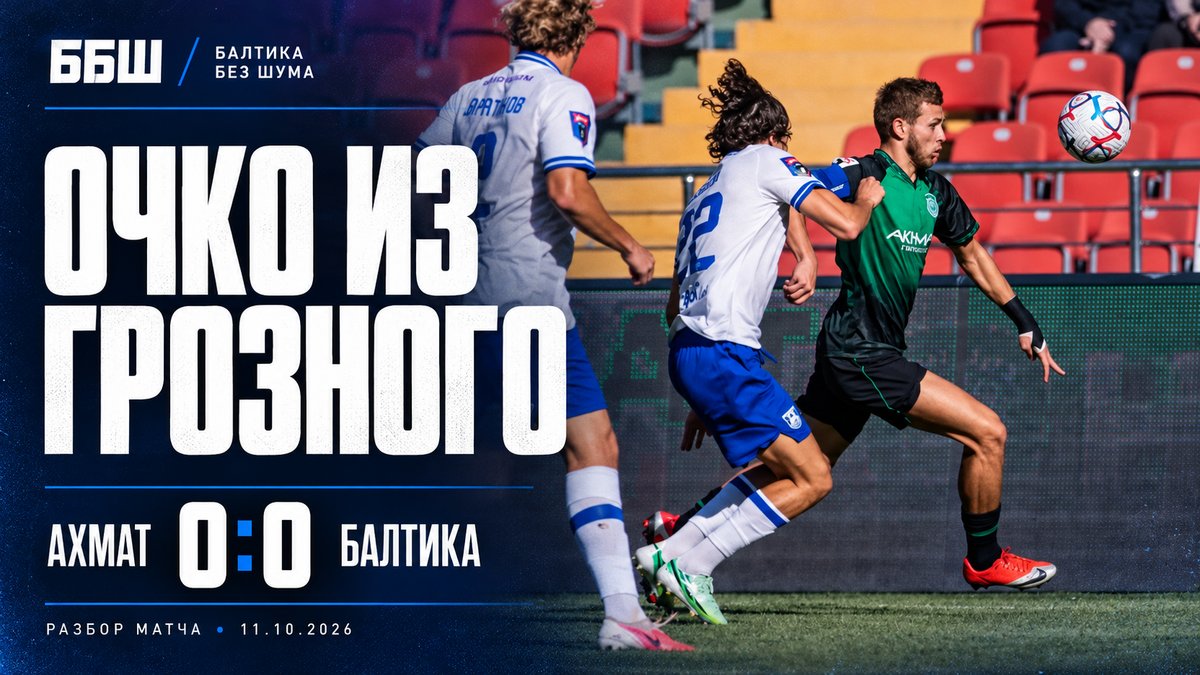
On shots Baltika matched the hosts in Grozny; on chances it did not. That contradiction is the whole match. The Kaliningrad side kept stepping into tackles and shot no less often than the opponent, but created danger more rarely. After the game Baltika's head coach called the draw a fair result and noted that in the first half the team lacked creativity in attack. The first part can be argued with; the second hardly.
Who was missing
Both teams came into the match with absences. Baltika lost Shnaptsev to injury. Murid didn't make the squad. Golenkov stayed on the bench with a knock and never came on. Akhmat were without the suspended Melkadze and the injured Samorodov.
Almost level on shots, not on danger
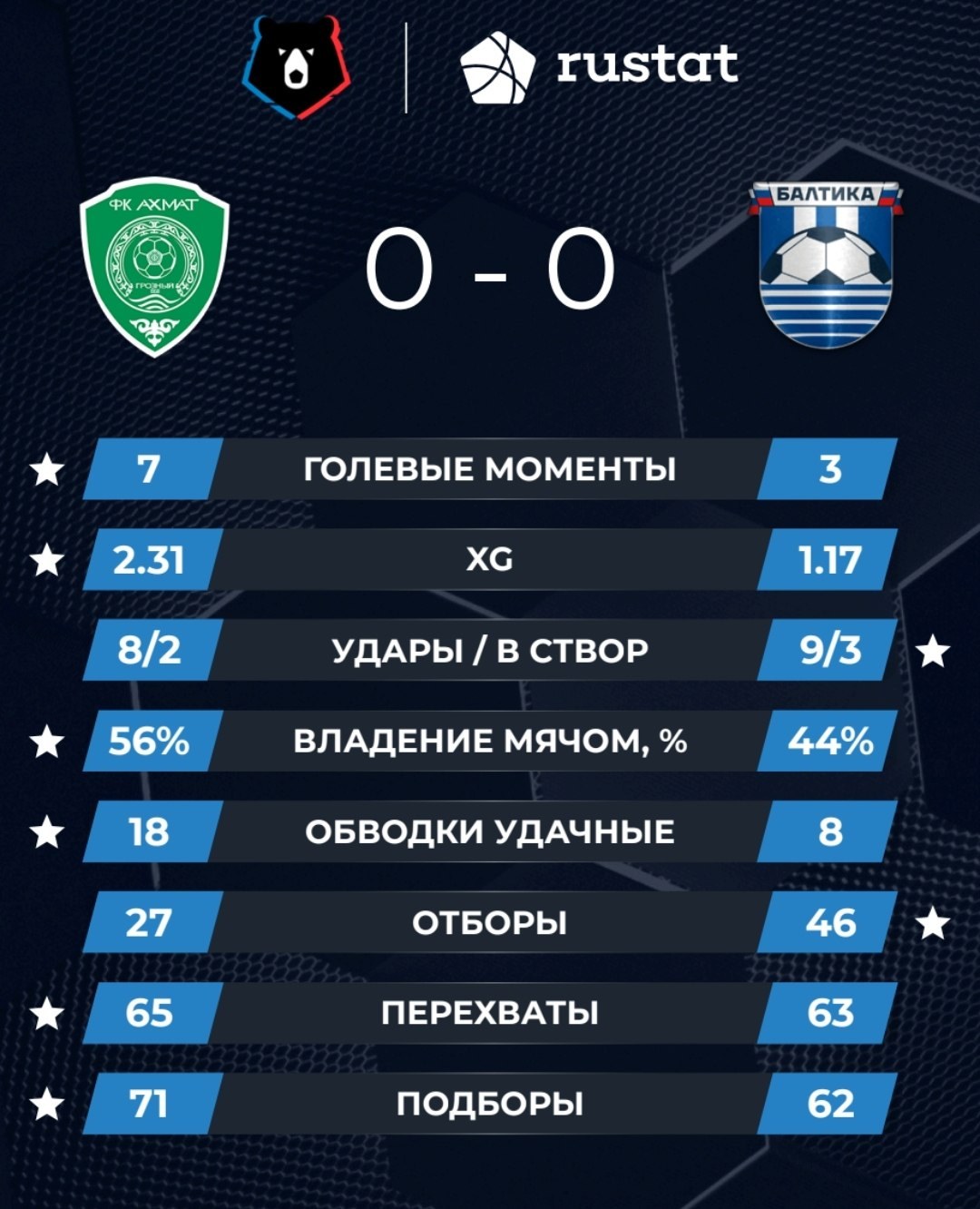
Both teams started in a 3-4-3. By the volume of attacking actions the match looked even: 8 shots for Akhmat, 9 for Baltika, 2 and 3 on target, three corners apiece.
The difference was in quality. The hosts had 7 goalscoring chances, Baltika 3. By the sum of RuStat's individual xG it was 2.31 against 1.17. Akhmat entered the box 17 times, Baltika 12. The hosts crossed more accurately (55% against 33%) and won duels more often (52% against 48%).
Baltika stepped into tackles more often (46 attempts against 27, with a 61% success rate against Akhmat's 70%) and pressed as a team more often: 27 episodes against 16. The ball, meanwhile, belonged mostly to the hosts: 56% possession, 490 passes against 427, 36 dribbles against 20.
The hosts' main threat came from Kasintura: four shots, three goalscoring chances, 1.43 xG — more than the whole of Baltika managed in the match. He hit the target once. Baltika's main attacking player was Maksim Petrov: five of the team's nine shots in 71 minutes, two on target, two goalscoring chances.
Two halves — two different degrees of worry
The overall numbers hide an important shift. Before the break RuStat counted six goalscoring chances for Akhmat and one for Baltika. Five of the Kaliningrad side's seven individual gross errors also fell in the first half. Latyshonok saved both on-target shots precisely then.
The problem the coach spoke about is easy to see in Offor: 43% pass accuracy, 29% of duels won, not one successful dribble out of three. At half-time Gil replaced him, and Mendel came on for Ilya Petrov.
After the break Baltika became more dangerous, even though it took fewer shots: four instead of five. But the goalscoring chances went from one to two. Akhmat moved in the opposite direction: six chances before the break and only one after, with not a single shot on target in the second half.
Both substitutions paid off: in 50 minutes Gil took two shots worth 0.67 xG — more than half of the team's total for the match — while Mendel added quality to the midfield: 85% pass accuracy, six attacking duels won out of six. The team raised its successful tackles from ten to eighteen. The whole shift can't be credited to two substitutions alone, but the improvement is visible.
So the overall 7:3 on chances needs a footnote. The hosts earned their edge in the first half. In the second, Baltika straightened the game out and got chances of its own — including Gil's two shots in a single attack after Civic's corner. The break clearly did the Kaliningrad side good. A pity goals weren't part of the improvement programme.
How the clean sheet survived
Latyshonok saved both shots on target and came off his line well. Baltika made no errors leading to goals, but there is no talking about a calm defence: RuStat counted seven gross errors between Gassama, Beveev, Varatynov and Ilya Petrov. Those errors didn't lead to goals conceded.
26 fouls is too many
Baltika committed 26 fouls against the hosts' 11 and picked up four yellow cards (Offor, Varatynov, Belikov, Mendel). Shiltsov made five fouls, Civic and Pospelov four each — and Pospelov spent 23 minutes on the pitch. That many fouls handed the opponent extra set pieces and raised the disciplinary risks.
What worked
Moving the ball forward. Baltika made more progressive passes than the opponent (112 against 106) and more clean progressive ones — 52 against 47. Its long passes were more accurate (75% against 61%), and the ultra-long ones went 10 out of 11. The team had the ball less often but delivered it forward no worse.
The verdict
For Baltika a point in Grozny is an acceptable result given the absences. But the similar shot counts shouldn't deceive anyone: Akhmat created slightly more danger. A normal game, we're in 7th, Rubin play a little later.
Baltika player ratings
The ratings are the editors' own, on a ten-point scale. The numbers are RuStat's; the tone is our responsibility.
Maksim Petrov — 7.0
Baltika's best. Five of the team's nine shots in 71 minutes. Maksim, it seems, was the only one to take the phrase "something must be done" as a specific assignment. Hit the target twice, had two goalscoring chances and created another for a teammate. The best Index in the team — 194. A goal belonged here. But with a goal this would have been a different review altogether.
Yevgeny Latyshonok — 7.0
Two shots on target — saved both. One coming out — successful. All five goal kicks — accurate. The kind of shift after which there is nothing in particular to discuss about the goalkeeper. For a goalkeeper, that is a compliment. Yevgeny's new moustache brought a clean sheet =)
Eldar Civic — 7.0
Nine passes into the box, two of them key, two shots, nine interceptions. Civic kept up with both helping the attack and dealing with its consequences. Won 73% of his defensive duels and took the ball in four tackles out of five. Four fouls spoil the reference slightly, but the reference is still positive.
Andrei Mendel — 6.5
Came on at half-time and offered a perfectly sound idea: the ball can be given to teammates. Pass accuracy — 85%, three quarters of duels won, six out of six in attack. Both dribbles came off. A very substantial appearance. There was a yellow too, but without one on this day you could feel like an outsider in this squad.
Loris Mouyokolo — 6.5
By the numbers the most reliable of the starting back three: 68% of duels won, 70% in the air, no recorded gross errors. Against the backdrop of seven such errors from four teammates, a notable virtue. Though he became notable precisely by not giving anyone extra reasons to clutch their head.
Eduardo Anderson — 6.5
Half an hour, five successful tackles out of five, 80% of defensive duels won. Overall — 73%. Came off the bench as if he had been listening attentively the whole time and already knew where his involvement was required. A very useful quality in a substitute.
Brayan Gil — 6.0
Two shots, 0.67 xG — more than half the team's total. With Gil on, there was finally someone a goal could be expected from. All we got, though, was the expectation. The fight was harder: 42% of duels won and two aerials out of seven. But he kept reaching dangerous positions, and in a match like this that is already a real contribution.
Mingiyan Beveev — 6.0
98 technical and tactical actions — more than anyone in the team. Ten interceptions, seven successful tackles from nine attempts. A workload that means complaints about effort will have to be addressed to somebody else. There are questions about quality: 66% pass accuracy and two gross errors. Mingiyan got a lot done. Unfortunately, including things better left undone.
Ivan Belikov — 6.0
Careful enough with the ball: 88% accuracy from 42 passes. In the fight — only 36% of duels won. It turned out to be a match in which coming to terms with the ball was noticeably easier than with the opponent. Six recoveries, three fouls and a yellow. There were useful actions; a complete performance didn't come together.
Konstantin Shiltsov — 6.0
Seven dribble attempts, six of them in the final third. Created a goalscoring chance, kept looking for a cutting edge. Thanks for the initiative: somebody has to ask the defence questions. But 30% of duels won and five fouls show that he often had to hear the answers himself. A busy, uneven match.
Nathan Gassama — 5.5
Nine interceptions, 71% of aerials won — things to praise. Three gross errors by RuStat's count — a reason to fall silent mid-praise. Won 46% of his defensive duels. The clean sheet, in this case, is more pleasant than the individual content.
Sergei Varatynov — 5.5
All five long passes accurate, nine recoveries. Things went better at a distance than on close acquaintance with the opponent: only 30% of duels won, and none of two in the air. Add a gross error and a yellow.
Ilya Petrov — 5.5
45 minutes, 75% pass accuracy, 43% of duels won, one gross error. Left no visible trace in attack. There are halves after which you want to discuss a player's role in detail. Here you wanted to see what the substitute would offer. Mendel offered enough.
Vladislav Pospelov — 5.5
In 23 minutes — four fouls and 29% of duels won. Entered the match energetically, but so far the energy registered best in the foul count. The attacking boost didn't happen.
Chinonso Offor — 5.0
43% pass accuracy, 29% of duels won, three failed dribbles out of three. A forward doesn't have to be involved in everything, but it helps if at least something comes off. This time the game didn't click in practically any department. The half-time substitution needs no further explanation.
Mikhail Ryadno — unrated
About ten minutes at the end. Enough time to step onto the pitch; too little for a fair verdict.
Is a point from Grozny a plus or a missed opportunity?


