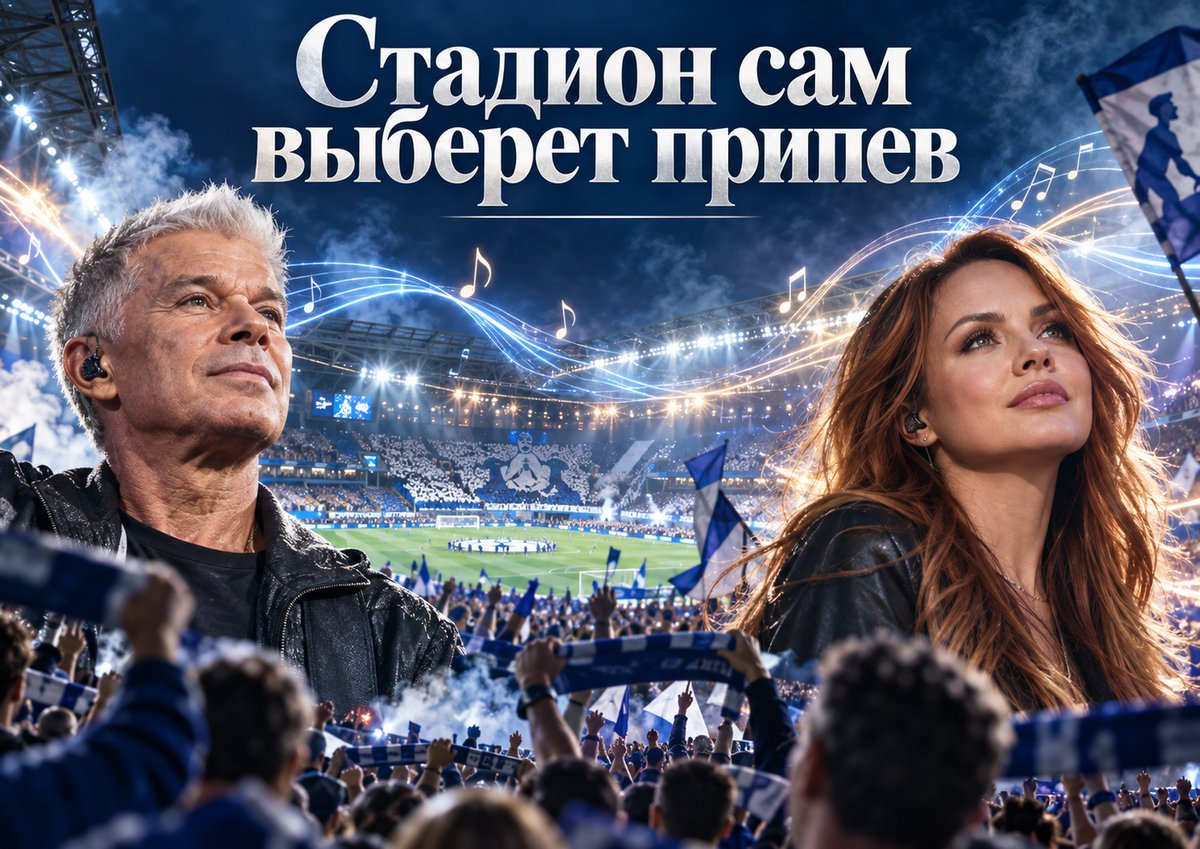
After football matches at the old Baltika stadium in Kaliningrad, silence did not always follow.
I remember how, at half-time and after the final whistle, the loudspeakers played a song in which Mikhail Kalinin drank beer with the people by the station kiosk.
He was in remarkable company. Kant, Schiller, Lenin, and the two bulls by the fleet headquarters.
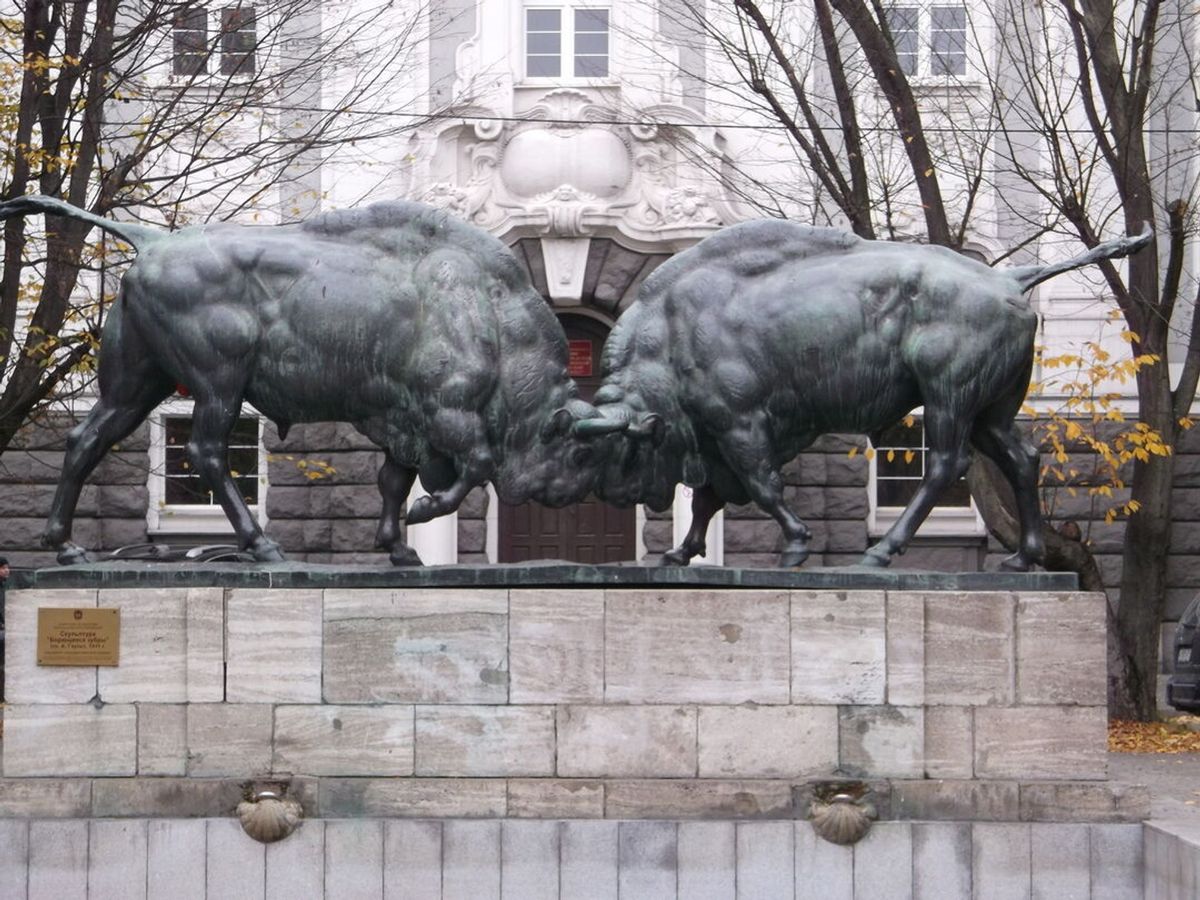
The authors gathered up Kaliningrad's landmarks, added a dash of local humour, and got a song impossible to confuse with the anthem of any other football club.
But the chorus is where it gets really interesting.
The authors wrote one set of words. The fans fairly quickly found a better version.
We will come back to that story.
Because once you start digging into the music of Russian football stadiums, an astonishing thing emerges.
Krasnodar have a composition by Hans Zimmer. Spartak have an official anthem by Viktor Drobysh. Zenit sing an old song about Leningrad. Fakel turned the music of Sektor Gaza into football music. And at CSKA, in a championship year, the stands sang about Argentina thrashing Jamaica.
And the most famous song of a club is by no means necessarily the one the club chose itself.
So who actually decides what plays at the football?
One march for the whole country
There was a time when the question was settled more simply.
Teams walked out to the "Football March" by Matvei Blanter, written in 1938. That same year the composer also wrote the music of "Katyusha".

For decades the familiar melody was part of the country's football.
You could be late for the start of a broadcast, miss the line-ups, fail to catch the announcer. But the moment the march struck up, everything was clear: the match was about to begin.
And in July 2009 Russian football very nearly lost this sound symbol.
The Russian Authors' Society demanded royalties for public performance. The league announced it would stop playing the march.
The most familiar musical ritual of the Russian championship turned out to be under threat over copyright.
The conflict was settled. The composer's heir Tatyana Brodskaya permitted public performance without the corresponding payments through the Authors' Society.
In 2018 the RPL allowed clubs to bring the teams out to their own anthem instead of Blanter's march.
The league's sporting director Viktor Pyshkin explained the decision simply: before that, the banners could be carried out to the club anthem while the players walked out to the march. That made two musical overtures.
The clubs got more freedom.
The fans, mind you, had not been consulted about any of it. They had long been choosing their music themselves.
Spartak and CSKA: the songs nobody commissioned
One of the most recognisable songs of the Russian terraces has nothing to do with football at all.
"Znayesh li ty" ("Do You Know") by the singer MakSim came out in 2006.
An ordinary lyrical ballad about love gradually turned into one of the musical symbols of Spartak Moscow.
And originally it could have been sung by quite different fans.
According to Sport24, one of the first to pick the song up was a company of CSKA fans on an away trip to Tomsk in the late noughties, presumably in 2008. Video recordings survive of the army-club sector performing it, and from other cities too.

But the song earned its true Spartak fame in Kazan.
On 20 April 2014, during the Rubin — Spartak match, it was played over the stadium sound system. The red-and-white sector began to sing along.
On 1 August the teams met in Kazan again. The big screen showed a video greeting from MakSim, a native of the city.
The familiar melody rang out — and the Spartak fans sang again.
Kazan showed off its native daughter. Moscow took the chorus.
The song became so recognisable that it was even used to greet the opposition. Before the final of the Russian Cup's Regions Path on 14 May 2024, Baltika laid on a musical welcome for Spartak: as the red-and-whites arrived at the arena, a barefoot woman sang "Znayesh li ty" to a guitar. That evening the Kaliningrad side won 1:0.
Then came the fan videos, the mass sing-alongs, the 2022 Russian Cup final at the Luzhniki, where MakSim herself sang in front of the red-and-white fans.
A month and a half later, before the Super Cup in St Petersburg, MakSim sang "Znayesh li ty" on hostile ground. Zenit's fans booed and tried to shout her down, while the Spartak sector sang along as best it could.
But it would be unfair to begin Spartak's musical history with MakSim.
In an interview with Sports.ru, one of the founders of Flint's Crew, Evgeny Safronov, recalled how back in 1993, before a match against Okean of Nakhodka, the Moscow fans were belting out the English football tune Here We Go. They used When the Reds Go Marching In as well.
And then Spartak acquired another unexpected hit.
"Luchshy gorod Zemli" ("The Best City on Earth") by Muslim Magomayev.

Music by Arno Babajanian, lyrics by Leonid Derbenyov. Originally — no football whatsoever.
As Safronov remembered it, in the spring of 2017 the song began to be sung at the futsal Spartak in Lyubertsy. From there it gradually made its way to the big stadium.
At first a few people sang. Then dozens. The song was becoming a habit.
On 25 August 2018, during the match against Dynamo Moscow, fans far beyond the active sector joined in.
So a new mass tradition was grown over more than a year. With no grand premiere and no specially commissioned video.
And yet Spartak do have an official anthem.
It was written by Viktor Drobysh and Roman Yemelyanov. It was presented back in February 2010, performed at the premiere by Roman Arkhipov of the group Chelsea. And in September 2014, at the opening of the new stadium, the anthem was sung by Valery Kipelov.

So it turns out that within one club, Drobysh, Kipelov, MakSim and Magomayev coexist quite peacefully.
CSKA's story is no less curious. And it began with a rather awkward encounter with Oleg Gazmanov.
As former player Artur Tlisov remembered it, at the 2003 championship banquet the CSKA players began chanting "Myaso!" ("Meat!") at the singer — they knew of his sympathies for Spartak. Gazmanov didn't finish his song and left the stage. And then, according to Tlisov, he stormed out angrily and complained to Semak, who was hosting the evening: "What kind of savages are these?"
Two years later the fans' musical choice proved no less unexpected.
On 20 May 2005, after CSKA's UEFA Cup triumph, a Sport-Express journalist ran into Vladimir Shakhrin of the band Chaif at Sheremetyevo airport.
Shakhrin was asked whether he knew that after the victories over Auxerre and Parma the CSKA fans had been singing "Argentina — Jamaica — 5:0".

The musician explained the song's popularity by saying it is not so much about victories as about football heartache.
The story itself is quite telling.
The army club had just won a European trophy. And they celebrated to a song about somebody else's national team, written after the 1998 World Cup.
In April 2008 Gazmanov took the CSKA stage again. At the celebration of the sports society's 85th anniversary he performed the shared anthem of the whole sports society. In the fans' archive the recording survives under the title "Nepobedimy CSKA" ("Invincible CSKA"). The irony is that a mere five years earlier, the army club's footballers had greeted the same artist with cries of "Myaso!".
Interfax reported one more detail: Gazmanov sang from a crib sheet, having had no time to learn the words. No arguing with that: the anthem was new even to its performer.

And in the summer of 2018 the football club CSKA presented a different official anthem: music by Alexander Dobronravov, lyrics by Natalya Kasimtseva.
But the music for a solemn ceremony and the song fans bellow at the airport after a European final are under no obligation to coincide.

Zenit and Fakel: when the city brings the music itself
The St Petersburg club's story began with a piece written long before modern fan culture.
"Vechernyaya pesnya" ("Evening Song") by Vasily Solovyov-Sedoy, with lyrics by Alexander Churkin, appeared in 1957.
People know it by its opening words about the city on the Neva.
It was written as a song about Leningrad, not about Zenit.

But in the winter break of 1980–1981 the fans composed their own words to the familiar melody. The song "Znamya Zenita" ("The Banner of Zenit") appeared at the same time.
Almost thirty years passed.
On 21 September 2010, at the presentation of the documentary "Our Name Is Zenit", veterans of the fan movement handed the club the rights to the text of the anthem they had created.
A rare story.
Usually a club commissions an anthem from musicians. Here the fans invented the words themselves, performed them for decades, and then officially handed the result over to the club.
Zenit acquired other musical works too.
The band Sekret prepared the song "Zenit — Champion!" on the basis of Chuck Berry's Johnny B. Goode. It began with the musicians' friendly teasing of comrades too obsessed with football.

In 2018 Leningrad presented "V Zenite". I've been to the St Petersburg stadium a few times — it sounds mighty good!

But a special place in the club's history still belongs to a song that came out of the city's culture.
And of course, there's no getting anywhere nowadays without The Hatters and "Gorod nad volnoy Nevoy" ("City on the Free Neva").

Voronezh's Fakel are in a similar position.
When people speak of the local terraces, the first thing they remember is "Tuman" ("Fog") by Sektor Gaza.
There are numerous recordings of matches where the fans raise their scarves and practically the whole stadium sings.

But it would be a mistake to think Fakel's musical history is confined to Yuri Hoy.
The club's fan archive preserves dozens of original works: "Nam nuzhen gol" ("We Need a Goal"), "Viva Fakel", "Tri tsveta" ("Three Colours"), "Vperyod, Voronezh!" ("Forward, Voronezh!") and others.
Especially interesting is "Voronezhsky bolelshchik" ("The Voronezh Fan") by Nikolai Zelepukin.
Back in February 2020, Vesti Voronezh reported that his song was played at half-time during Fakel's matches. And later the club published a video in which the author himself starts singing and the stand picks it up.
Fakel also have a fan anthem by the group Tony Tyler, presented in 2022.

So the Voronezh stadium sings more than just the songs of its famous rocker.
Original football music has long been made here too.
Lokomotiv and Dynamo: when the club carefully preserves someone else's chorus
The official site of Lokomotiv Moscow has a section with the eloquent title "We Sing for You, Lokomotiv Moscow".
It is a genuine fans' songbook.
"Put parovoza" ("The Way of the Steam Engine"), "Tri gola" ("Three Goals"), "Krasno-zelyonye" ("The Red-and-Greens"), "Utro krasit yarkim svetom", "Dozhd" ("Rain"), "Yug" ("South") and dozens of other chants.
The fans' songbook on the Lokomotiv website
Some songs were recorded professionally.
In the early 2000s the band Dyorgat! released fan tracks under the name Red-Green Division. The United South archive preserves "Tri gola", "Red-Green Hooligans" and "Vikings".
Lokomotiv's official anthem was written by Avgust Krepak.

But what makes this story distinctive is something else: the club not only creates its own music, it preserves the songs of the terraces as cultural heritage.
Dynamo Moscow took a similar path.
The official site holds a large musical archive: "Dinamo — eto klass!" performed by Samotsvety, songs about Lev Yashin, compositions by Alexander Marshal, Nikolai Mikheev and the group NZ.
There is even the story of the choreographic picture "Football", staged by the Igor Moiseyev ensemble back in 1936 and dedicated to the rivalry between Dynamo and Spartak.
The modern anthem was written by Nikolai Arutyunov, a long-standing fan of the club.
On 26 May 2019 Nikolai Arutyunov himself performed the new anthem at the stadium opening, accompanied by a symphony orchestra. And on 21 July, before the match against Rubin, it was performed by Lev Leshchenko and Sergei Arutyunov, the composer's son. Both performances are described in Dynamo's own reports.

The piece has a rock arrangement too.
The official site reports that the anthem opens home matches.
It is an important example: an official song is not necessarily dreamt up by people far removed from football.
Sometimes it is written by a man who has himself stood on the terrace for years.
Baltika: Kalinin, the pigeon-toed bear and the people's edit
Back to Kaliningrad.
When I began collecting memories of the songs of the old Baltika, it turned out the club's musical history is considerably older than the familiar anthems and videos.
Some readers remembered the eighties. According to them, the stadium then sang "Solnechny krug", "Mishka kosolapy" ("The Pigeon-Toed Bear") and assorted chants, many of them forgotten today.
A trace of the "Bear" does indeed survive in old internet collections. There, the children's ditty no longer ends with the usual words, but with "Baltika-Kaliningrad".
The year this rewrite appeared, admittedly, is not documented. It is fans' memories that place it in the eighties.
The nineties, though, left considerably more traces.
In 1996 a company of active fans began gathering on the South Stand. In 1997 König Legion was born.
One participant of the movement told RUGRAD how they sewed banners themselves, watched English films, picked up the know-how of visiting fans and invented chants.
Some they borrowed. Some they composed themselves.
Memories of the König Legion veterans — RUGRAD
In the BBSh discussion people also remembered the jokey chant about Madonna and Maradona, which existed in various versions among fans across the former USSR.
But the most recognisable song of the old Kaliningrad stadium appeared back in the early nineties.
"Baltika! Baltika!" Do give it a listen

The words were written by Valery Abarov and Maksim Mikhailov. The music and arrangement were prepared by Abarov and Igor Shpenkov.
This was not just another song about a team. The authors effectively packed the whole city into it.
Kant, Schiller, Lenin, the two bulls by the fleet headquarters.
And Mikhail Kalinin, drinking beer with the people by the station kiosk.
And now — the promised bit about the chorus.
The original text said you should sing:
"Boley, boley, boley!" ("Cheer, cheer, cheer!")
But in fan circles another version appeared:
"Naley, naley, naley!" ("Pour, pour, pour!") Many didn't even know which one was actually correct)
Both versions, notably, survive in an old collection of Kaliningrad chants. The authors, of course, were calling on people to support the team.
So were the fans. They just somewhat expanded the support programme. Considering what Kalinin was up to by the station, the rewrite looked like a logical continuation of the authors' idea.
I remember this song being played at half-time and after matches. It was a familiar part of a football evening.
And this isn't just old fans' memories. On 22 January 2010 Novy Kaliningrad published a comment by the club's press attaché Vitaly Makarov. The management intended to commission a new anthem from professional composers. Makarov acknowledged that the old song was enormously popular, but stressed its unofficial status.
The club, he said, needed a more official note. He assumed, at the same time, that the old composition would remain the fans' main folk song.
The club already had a popular song. The management simply wanted a more ceremonial one.
Other works appeared later.
In 2021 DiskoDyadi recorded "Baltika, vperyod!" ("Baltika, Forward!"). There was a club video, players, fans. My little son adores it =)

There is Firuz Tairov's song "Baltika — Kaliningrad" with the chorus "You're my friend, I'm your brother".

As participants of the discussion in my Telegram recall, the sector also sang a rewrite of the Mirazh hit — "Baltika nas svyazala" ("Baltika Bound Us Together").
A separate story is Oleg Gazmanov's "Baltiysky Bereg" ("Baltic Shore").
The local press calls it the unofficial anthem of Kaliningrad football.
But in the BBSh discussion opinions split. Some like the song; others flatly refuse to count it as their football tradition.

Some remembered the stadium playing quite different things, including Bulat Okudzhava's "Nam nuzhna odna pobeda" ("We Need One Victory").
Argue all you like, but it is to "Baltiysky Bereg" that the team walks out at the Rostec Arena today. I go to Baltika's home matches and hear it myself.
And here is what's especially amusing: Gazmanov turned out to be the voice of three club histories at once. He was born in Gusev, Kaliningrad Region. In the nineties he wrote "Spartak, We Are Always with You" — he had been impressed by Oleg Romantsev's team. Later, after that ill-fated army-club banquet, he performed "Nepobedimy CSKA" at the sports society's jubilee. And now his "Baltiysky Bereg" accompanies Baltika onto their home pitch.
One singer — three clubs. And two of them, to put it mildly, cannot stand each other.
For Baltika itself, "Baltiysky Bereg" lives beyond the pre-match programme too. In January 2026 Nikolai Titkov revealed that the players constantly put the song on in the dressing room, and that he himself performed it at the celebration of the First League title. There is a funny rhyme to it as well: in the same interview Titkov admitted that as a child he supported Spartak.
So Baltika's musical history is far richer than the modern club videos might suggest.
There were Soviet children's songs, backyard chants, fan rewrites, recordings by local musicians and attempts to create an official anthem.
And in the memory, Mikhail Kalinin still stands.
By the station kiosk.
With a thoroughly optimistic attitude to football results.

Rubin and Rostov: the words were handed out, but will the people sing?
Kazan's Rubin have a musical story that could pass for a comedy script. In October 2013 a fan site published a selection of songs about the club.
It mentioned an anthem written and performed by Marat Berdyev, son of the coach Kurban Berdyev.
According to the author of the piece, the recording and arrangement were done in a well-known London studio. Its name, however, he did not give, and there is as yet no independent confirmation of that detail.
But the most interesting thing in the publication isn't even London.
The authors recalled how they tried to turn the "Ode about Rubin" into a song for the whole stadium.
To that end, leaflets with the lyrics were handed out at the Central Stadium. Everything, it seemed, had been thought of. The song exists. The words are printed. The spectators have come. All that remains is to sing.
It didn't work.
As the author of the publication remembers it, the idea of a mass performance never caught on.
In general, the internet is full of songs about Rubin, from the very old ones right up to some from this July.


On the Don they tried to solve a similar problem a little differently.
I'll confess honestly: one of my favourite songs!

In July 2006 Rostov announced a competition for new verses to the song "Rostov-gorod" by Matvei Blanter, with lyrics by Anatoly Sofronov.
The first verse was kept. The rest the fans were invited to compose.
The goal was clear: to get the whole stadium singing.
The competition is confirmed by archive publications. But convincing evidence that the new version immediately became a mass terrace tradition has yet to surface.
Later "Rostov-gorod" was mentioned on the club's official site as the anthem played seven minutes before home matches. That refers to the archived programme of that period, not to a confirmed running order for the 2026/27 season.
Archived FC Rostov page — saved in February 2019
The fan sector, meanwhile, lived a different musical life.
For many supporters the club was still Rostselmash — and the old name lived on in the chants.
The fan archives preserve the songs "Nash Rostselmash nepobedim!" ("Our Rostselmash Is Invincible!"), "Vperyod, nash klub" ("Forward, Our Club") and others.

And that is a curious detail.
In the official documents the club's name changed long ago.
On the terrace it kept on sounding.
Sometimes a football song preserves what has vanished from the signboard better than a history museum does.
As a bonus, a video by Noggano, a.k.a. Basta — but it's 18+, so careful

Krasnodar: Hans Zimmer versus two words from a police loudhailer
In December 2019 Krasnodar announced a collaboration with Hans Zimmer.
The composer, known for Gladiator, Interstellar and dozens of Hollywood films, wrote music for the club. The arrangement was done by Anton Belyaev.

The premiere took place on 27 August 2021 before the match against Rubin. But there is one subtlety.
Instrumental music for the players' ceremonial entrance and a song tens of thousands of people are meant to sing are works with completely different jobs.
The first creates an atmosphere. The second demands a simple melody, a clear rhythm and the desire to sing.
And the difference showed especially well after Krasnodar's first championship in 2025.
Murad Musaev told Sports.ru how the city celebrated the title.
People poured into the streets, cars filled the centre, everyone was singing and shouting. And police cars drove around the city starting a call-and-response over their loudspeakers.
— Cherno!
— Zelyonye!
Hans Zimmer wrote Krasnodar a grand instrumental composition. And after the championship, two words proved enough for the city. With the police as the ones leading the chant.
There are also various fan songs online; here is one example

Krylia Sovetov and Akron: music on a schedule
In Samara, in the summer of 2026, they set out to decide what music should play after Krylia Sovetov goals. Fans were invited to send in suggestions.
The lists featured Darude, Avicii, Gala, Scooter, songs from Smeshariki and even "Trava u doma".
Voting began. And almost immediately a problem arose that any organiser of internet contests will recognise.
Vote-rigging.
The club admitted that identifying an honest winner from an open vote was impossible. In the end the decision was handed to the players.
The winner was Maria (I Like It Loud) by Scooter.

The option, incidentally, had originally been proposed by the fan Nikolai Pishchakov. On 16 August the song was played for the first time, after Ivan Oleynikov's goal against Dynamo Makhachkala.
Krylia, mind you, lost the match 1:4.
And here a wonderful piece of football irony emerged.
The music was chosen by the fans, then by the players — and when it was finally played, the spectators cheered so loudly they almost drowned out the recording. The club reported this itself.
A year earlier Krylia had presented a new club anthem performed by Pavel Vorobyov of COMEDOZ. I rather liked it, by the way =)

The idea, by the club's account, originally came from the fans too.
There are songs by the group Dabro as well

And I can't skip the hooligan one, 18+ =)) Click
At Togliatti's Akron things are arranged even more interestingly.
The official site carries instructions for the active support sector.
They list the chants, the call-and-responses, the rules of conduct, the fans' meeting point. And a separate item:
"Katyusha" — we sing it in full on 80+ minutes.
The Akron fan sector instructions

This is no longer the announcer's musical taste or a random track after a goal. It is part of the planned support.
Almost ninety years ago Matvei Blanter wrote "Katyusha". In 2026, fans of an RPL club are told at which minute to start singing it.
And Blanter's other famous melody, the "Football March", remains perhaps the most recognisable sound symbol of a match about to begin — though it no longer plays at every arena. The composer, it seems, has kept stadium sound engineers in work for generations to come.
The club is young, but look what fun songs they already have!

Orenburg, Akhmat, Dynamo Makhachkala and Rodina: the songs are still being written
Orenburg's musical history preserves an anthem from the Gazovik era which mentions Rostoshi — the district where the stadium stands.
The result is a thoroughly practical piece: it not only supports the team, it effectively tells you where to go for the football.

And on 15 April 2026 the club presented a new song and video for its anniversary.
It combines football footage, the city landscape and local symbols. Upbeat stuff, what can you say — recommended)

Take the city, add the team, look for words in which people can recognise themselves.
Grozny's Akhmat have an anthem performed by Beslan Dakaev, released in 2017.

But back in the Terek days the fans were already creating songs and shooting their own videos. There was, among other things, a rap track about the club.
In Grozny, the national anthems of Russia and Chechnya are played separately before matches. That is part of the ceremony, and it's important not to confuse it with the club's musical tradition.
Nikolai Baskov has even sung at the Akhmat Arena!

Dynamo Makhachkala got the song "Dinamo Makhachkala" by Mon El and Archi-M in August 2025. A properly stylish track, as it turned out!

But far more interesting is the account of Iskander Velikhanov, head of the Kaspiyskaya Flotiliya fan movement.
After matches the players come over to the active sector. The fans chant the team's name, a drum beats, the players join the shared salute.
And only then do they head for the dressing room. Here, uniting the team with the people requires no elaborate melody at all. A rhythm is enough.
There are older songs online too

As for Moscow's Rodina, playing in the RPL for the first time, a full musical history could not yet be reconstructed from open sources.
No reliable confirmation was found of a current official anthem, walk-out music or an established song repertoire. That does not mean there are no songs.
The club simply doesn't yet have the kind of publicly documented musical past that many of its rivals have accumulated. Perhaps the most interesting part is only beginning.
But there are songs on the official page after all

The last word still belongs to the stadium
While preparing this piece I read dozens of stories about football clubs searching for their own music. They invited composers. Recorded anthems in studios. Printed lyrics on leaflets. Shot videos. Asked fans to vote. Composed new verses to old songs.
Sometimes it worked. Sometimes it didn't. But almost all the genuinely living stories share one circumstance.
A song became a football song not at its premiere, but when the people themselves started doing something with it.
Zenit's fans rewrote a city song and kept it alive for decades. The Spartak faithful made a MakSim ballad their symbol. Voronezh turned its hometown's music into part of its football. In Rostov the club's former name lived on in fan songs after it vanished from the official documents.
And in Kaliningrad the authors of one old song wrote "Boley" — "cheer". But the stadium heard it its own way. And sang: "Naley" — "pour"!
Since then, coaches, players, stadiums, musical formats and whole generations of fans have changed.
What remains is a fairly simple rule.
A club can commission an anthem. But the last line will still be written by the stands.


