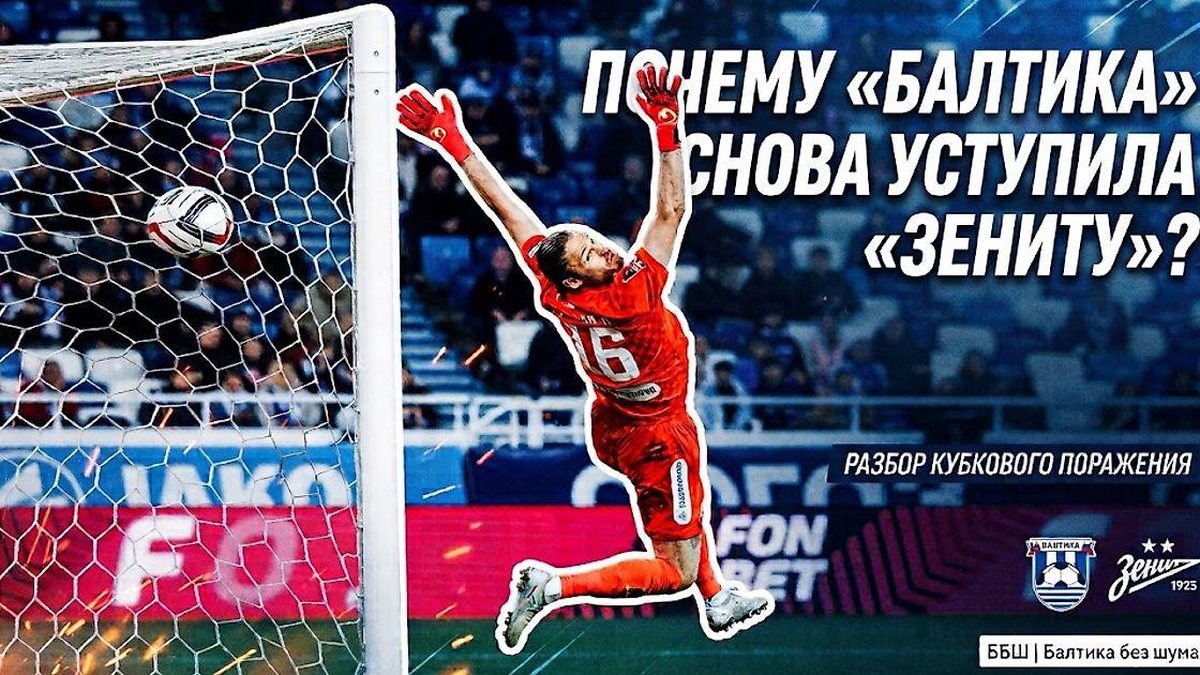
14 shots to six, 22 entries into the penalty area to six. And a 2-3 defeat on the scoreboard. We break down Baltika's paradoxical cup match against Zenit: the managers' decisions and every player's performance, backed by RuStat data.
29 October 2026. Russian Cup, RPL Path, group stage, matchday five. Kaliningrad, Rostec Arena. Attendance: 10,644.
Baltika took 14 shots to Zenit's six. The Kaliningrad side put seven on target to their opponents' four. They created five clear chances to three, entered the opposition penalty area far more often, pressed more effectively and won more duels.
Yet Zenit won.
It was not simply a matter of the St Petersburg club having more expensive, more technically gifted players. Individual quality certainly played a part, of course.
This game exposed two sides of the current Baltika. One is a team capable of imposing its football on Zenit, forcing mistakes and dictating terms for long spells. The other is a team capable of undoing an enormous amount of good work in a matter of seconds.
And it is the second side that still needs work.
First half: almost perfect, unless you look at the score
Talalaev named a largely experimental line-up but did not abandon his familiar approach. Baltika started in a 3-4-3. Gassama, Kirsh and Varatynov formed the back three; Ryadno and Moufi operated out wide, Murid and Belikov played centrally, with Pospelov, Offor and Kovac up front.
Zenit lined up in a 4-2-3-1, although their shape became more fluid in possession: Karavaev could move closer to the centre-backs while Volkov pushed higher along the flank.
But for the first half-hour the visitors could not find a comfortable way to play through the pressure.
Offor constantly harried the defenders as they tried to build from the back. Pospelov and Kovac joined the press, while Belikov and Murid worked to close off passing lanes through the middle. Baltika repeatedly regained the ball in Zenit's half and quickly advanced it towards the penalty area.
Ryadno, Pospelov and Offor were particularly lively. Baltika's pressure came not just from long balls and physical contests but from purposeful progression in possession.
Then, in the 30th minute, Zenit scored.
Daniil Kondakov drove the move forward through the middle. John John produced a deft backheel to Roman Vega, the Argentine drilled a low ball across the box, and Kondakov continued his run to meet it first-time and open the scoring.
A fine combination. Behind it, though, lay a whole chain of mistakes by the hosts. Talalaev explained in considerable detail after the game exactly where his players had gone wrong. We will come back to that.
Conceding did not break Baltika. In the 37th minute Offor capitalised on Alip's error, dispossessed him inside the box and found himself facing Adamov. The striker shot, but Zenit's goalkeeper kept the visitors ahead. Later Adamov made another excellent save, this time from Moufi's close-range header.
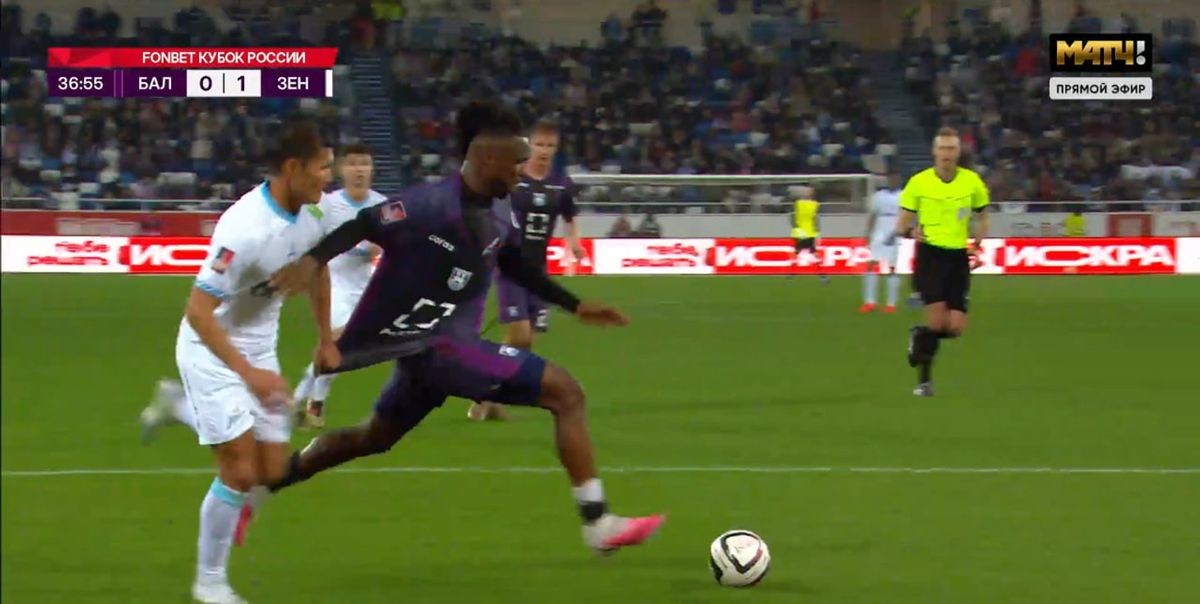
By half-time Baltika had taken eight shots to Zenit's three. But they went into the dressing room a goal down.
After the game Talalaev described his team's first half as very good. Judged by how well they executed the game plan, it is hard to disagree.
Unfortunately, football has an awkward habit: executing a plan correctly does not score goals by itself.
Second half: when mistakes become too expensive
Both managers changed a centre-back at half-time. Mouyoukolo replaced Varatynov for Baltika. Semak brought on Nino for Alip, an understandable decision after the Kazakhstan defender's mistake had almost gifted away a goal.
The second half began less convincingly for the home side. Zenit became more assured in possession, and Baltika's high press no longer won the ball back in dangerous areas as frequently as before.
In the 61st minute Talalaev made a triple substitution: Beveev, Golenkov and Porokhov came on. Porokhov replaced Murid, a change that noticeably altered Baltika's attacking play.
But first, Zenit struck again.
In the 69th minute Luis Henrique helped launch a counterattack, John John found Felipe Augusto, and the Brazilian beat Mouyoukolo before placing his shot into the far corner.
0-2. Even though Baltika were still doing more of the attacking work.
Four minutes later came the sort of moment that makes football worth watching even when the result seems decided.
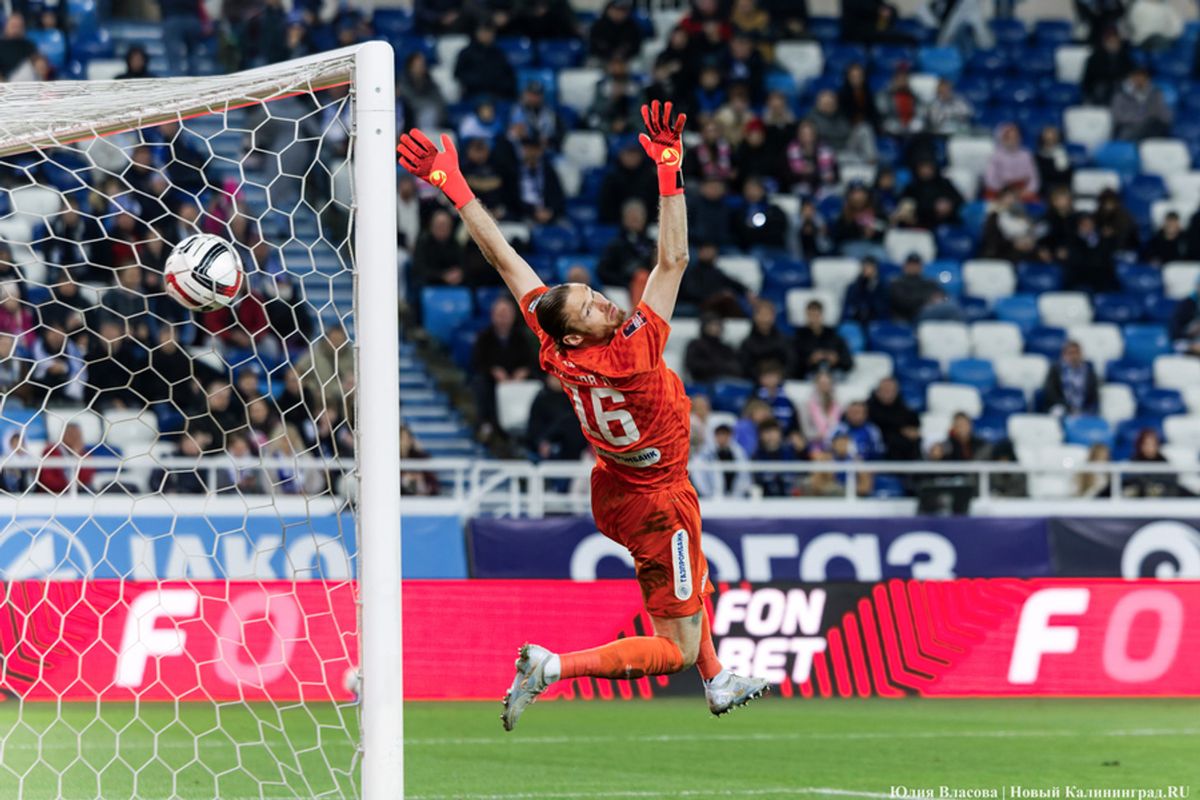
Moufi passed to Kirsh, and from an extraordinary distance the defender sent the ball on an astonishing trajectory beyond Adamov. The keeper could only watch it sail past.
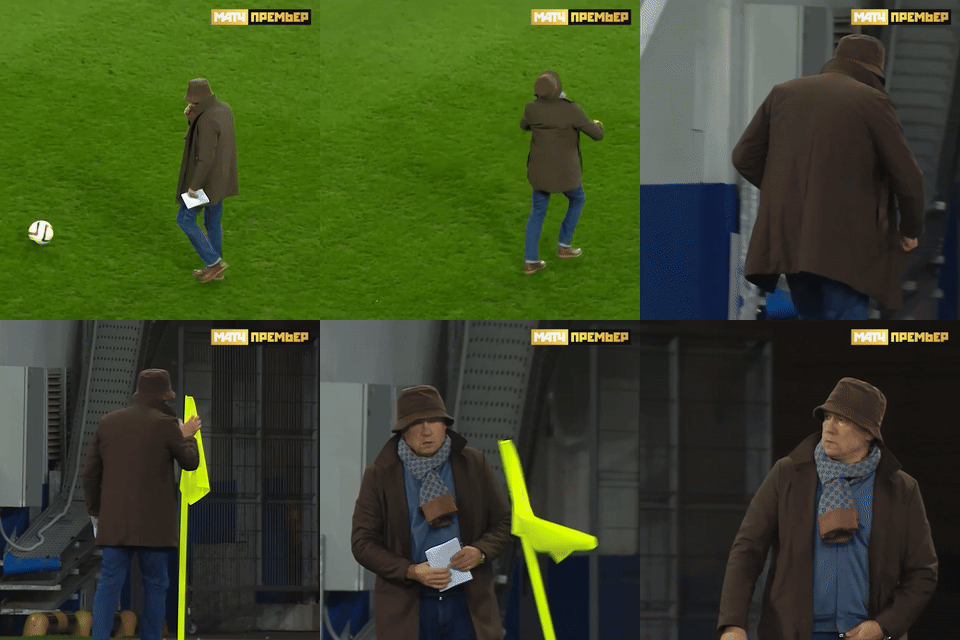
Talalaev was so astonished that he took his hat off. There was far too much talk about that hat on Telegram and at the press conference. Better to appreciate Andrey Viktorovich's technique — and he was even wearing dress shoes!
The best part is that Kirsh himself admitted afterwards that he had actually been trying to cross. The ball came off his foot differently from what he intended.
The result was considerably better.
According to RuStat, the combined xG of Kirsh's two shots in the match was just 0.02. Goals this improbable usually exist somewhere in theory. This time one materialised at Rostec Arena.
Baltika were back in the contest, but not for long.
In the 83rd minute Karpukas found Kondakov in the area. The young midfielder delicately lifted the ball towards Felipe Augusto, who completed his brace with a powerful volley.
Again, outstanding execution. And again, questions for a home defence that had allowed a combination to unfold in such a dangerous area.
In stoppage time Ilya Porokhov reduced the deficit with a shot past Nino. Baltika pushed forward looking for a third, but there was no longer enough time to complete the comeback.
2-3.
Zenit secured first place in the group. After five matchdays Baltika remained third. Nevertheless, they are through to the next round of the Russian Cup, which is certainly welcome news.
And we witnessed a match in which the home side did an awful lot to deserve victory. Everything, that is, except the most important thing.
What RuStat tells us
Now let us move from impressions to the figures.
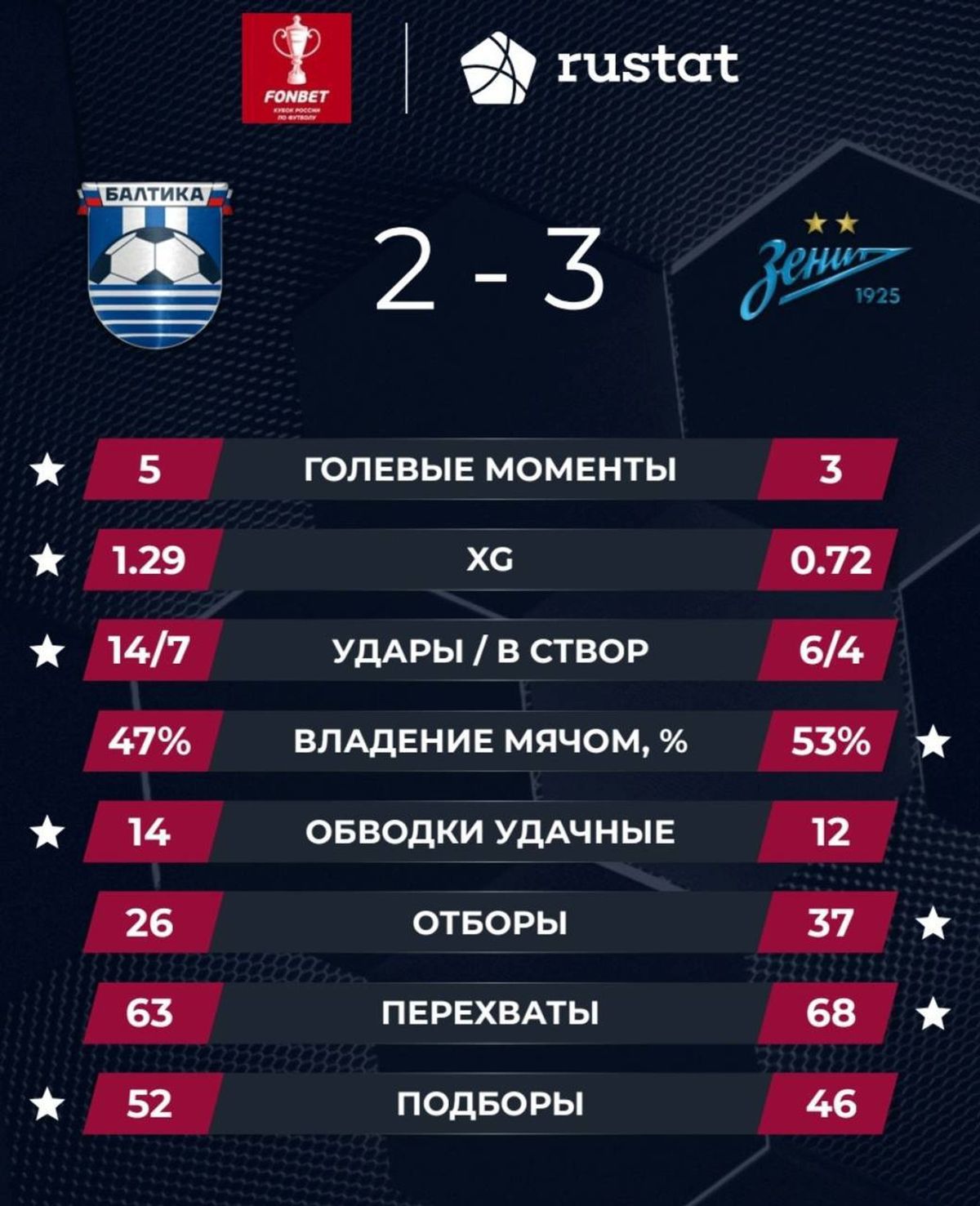
There are three numbers worth examining separately, and not all of them appear in the graphic above.
First: pressing. Baltika did more than simply contest possession under pressure more often. They were far more effective at it. Their successful team-pressing rate was 68%, compared with Zenit's 42%. Zenit lost the ball in their own half 32 times; Baltika did so just ten times.
This confirms that Talalaev's plan was working. Zenit had real problems playing out from the back.
Second: penalty-area entries. The count was 22 to six. Add 53 actions inside the opposition box to Zenit's 18. In other words, Baltika reached the areas where goals should theoretically be created much more often.
But that numerical advantage did not translate into a comparable lead on the scoreboard.
Third: xG. Here we need to abandon the popular explanation that Baltika simply squandered an enormous number of chances.
They scored twice from 1.29 expected goals, actually outperforming the model. Zenit, meanwhile, scored three goals from just 0.72 xG.
That does not mean the visitors were simply lucky. Kondakov and Augusto executed their finishes superbly. But the figures show just how unusual the result was relative to the quality of chances created.
Zenit converted all three clear-cut chances counted by RuStat.
That was the difference.
A separate note on the refereeing. RuStat recorded 20 fouls by Baltika and just four by Zenit. It is a striking disparity, but it would be wrong to draw conclusions about Mikhail Plisko's refereeing without examining the individual decisions. In my view, the referee made mistakes in both directions; it was not the young official's finest performance.
Incidentally, he was born in Kaliningrad but has lived his whole life in the Leningrad region. An interesting twist of biography.
Tactical analysis: where Baltika's game broke down
Baltika's main objective was to prevent Zenit from building comfortably from the back.
Offor initiated the pressure on the centre-backs, with Kovac and Pospelov helping shut down options out wide. Ryadno and Moufi pushed higher, while Belikov and Murid tried to get tight to players receiving passes between the lines.
When the system worked, Zenit found themselves in an uncomfortable position: the ball near their own goal and hardly a free teammate in sight. That explains the sheer number of turnovers in the visitors' own half.
But a high press always comes with risk. The more players push forward, the more space is left behind them.
If the opposition beats the first wave of pressure, the defenders have to make quick decisions with very little margin for error.
That was where Baltika struggled.
The first goal: four mistakes in one move
Talalaev's post-match explanation deserves close attention. The coach effectively reconstructed the entire sequence leading to Kondakov's goal.
First, Kovac failed to stop the attack. According to Talalaev, he should have committed a tactical foul while pressing rather than allow Zenit to progress quickly.
Next, Belikov gambled on an interception. Ivan tried to anticipate the pass but could not win the ball, leaving space open behind him.
Then Baltika allowed the cross from the flank. John John's combination with Vega was stylish, but the defenders failed to prevent the final ball.
Finally, the marking broke down inside the box. Talalaev said Baltika had six players there against three from Zenit when the goal was scored.
The numerical advantage counted for nothing.
That is why looking for a single culprit makes little sense. Each mistake compounded the previous one until Kondakov was free to finish the move.
It was especially frustrating because, according to Talalaev, his team had already conceded a similar goal against Zenit. The coach even threatened to send one of his players to the reserve side if that particular mistake happened again. He did not name the player, so attaching the warning to any one footballer would be speculation.
But the message is clear: making a mistake once is understandable. When the same error keeps recurring, questions arise about learning and discipline.
What changed after the 61st minute?
Talalaev's triple substitution was a key moment. Beveev brought fresh legs to the defensive line, Golenkov added a more physical presence up front, and Porokhov's introduction enabled Baltika to finish attacks with shots much more often.
Pospelov also started operating more centrally, taking part not only in creating danger but in moving the ball upfield. As the match progressed, Belikov frequently dropped deeper to help construct attacks.
It is important not to mistake a formation diagram for a heat map: it shows the allocation of roles, not every player's movement. Still, the shift in attacking emphasis after the substitutions was clear from how the team played.
Porokhov stands out in particular.
He only came on in the 61st minute but took four shots, three of them on target, and scored.
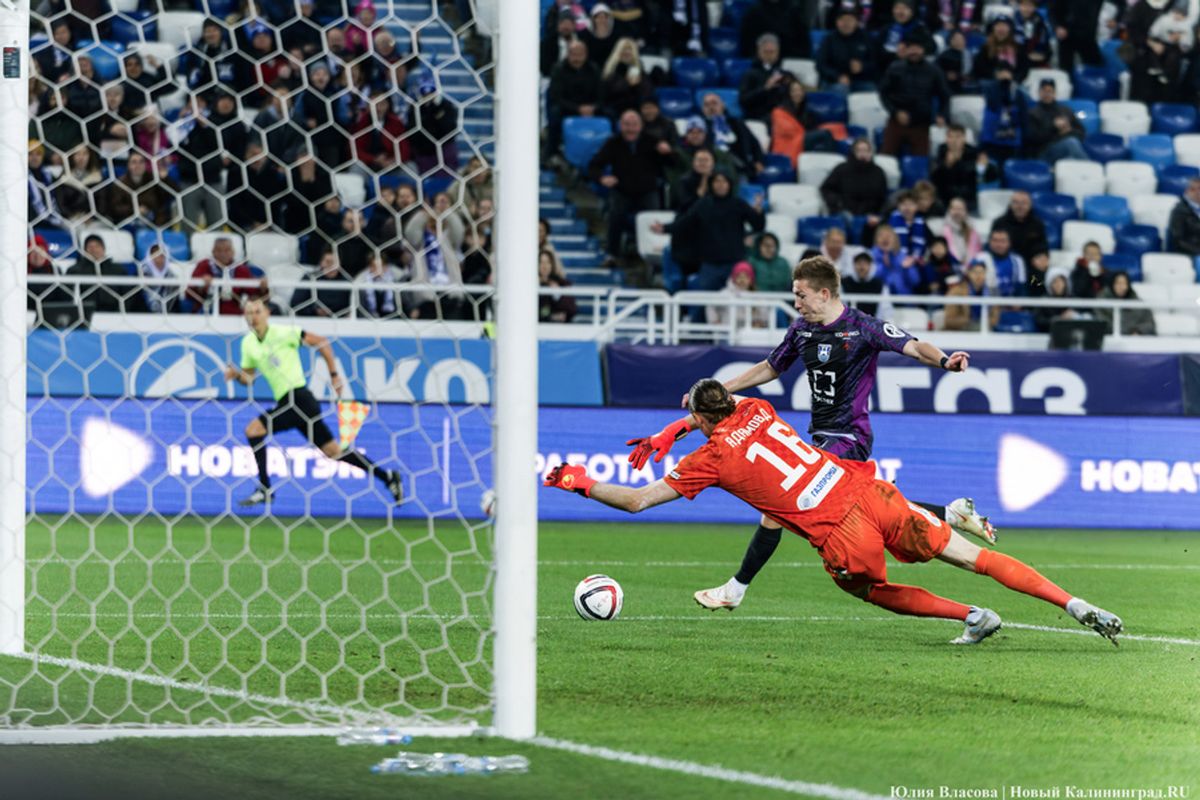
Baltika had six attempts in the entire second half. So one player accounted for two-thirds of the team's shots after the break.
But there was a downside to the reshuffle.
A bolder attacking approach demanded exceptional precision in reacting to turnovers. And Baltika's defence was already struggling at times with Zenit's quick transitions.
The second and third goals both came after the triple change. That does not mean Talalaev's substitutions caused them. But the reshuffle did not make Baltika more secure defensively either.
Felipe Augusto: two very different goals, one recurring problem
The Brazilian's first goal, in the 69th minute, came from winning an individual duel. Mouyoukolo was facing the forward, but Augusto wrong-footed him and created the space to shoot.
For the second, Zenit used a combination right inside the penalty area. Karpukas found Kondakov, who set up Augusto, and the striker volleyed into the net.
Two quite different moves, united by one thing: Baltika allowed an opponent to take the final action in comfortable conditions.
We can argue about exactly who should have defended better. But when opponents have so few attacks and can still finish their combinations so freely, the coaching staff have something to address.
That is the central contradiction of this match.
Baltika are excellent at making life difficult for opponents. What they are not yet so good at is defending reliably when an opponent does find a way out of those difficulties.
And this is not a question of a 3-4-3 formation or the number of duels won.
It is a question of individual decisions.
So what is the verdict?
Talalaev said afterwards that he was pleased with the team's performance, especially the pressing, but acknowledged that the defensive problems have to be fixed.
It is hard to argue. Baltika produced plenty of good spells, forced Zenit into mistakes and regularly found a route into the opposition penalty area. Their young players gained valuable experience against strong opponents.
But competing well is one thing. Turning your superiority into a result is quite another.
To beat Zenit, it is not enough to force them into errors. You must punish those errors while avoiding your own.
In Kaliningrad, Baltika managed the first part, but not the second.
Now let us look at the individual performances, and how closely RuStat's ratings match what we saw on the pitch.
Baltika player ratings
Starting XI
Egor Lyubakov — 5.5
Three goals conceded from four shots on target. The kind of statistic any goalkeeper would rather forget quickly. But RuStat did not attribute any goal-leading errors to Lyubakov, and Zenit really did finish their chances brilliantly.
Egor looked assured with the ball at his feet: 19 accurate passes from 23 attempts, including seven successful long balls out of 11.
It would be wrong to blame him for every goal conceded. But he did not produce the kind of save that might have changed the result either. No glaring failure, but no goalkeeping heroics.
Natan Gassama — 5.5
Nine interceptions and 88% passing accuracy. From those figures you might assume the defender had an excellent game. But look a little closer.
He won just five of ten duels, including only one of four in the air. Gassama also received a yellow card as early as the 24th minute, restricting how aggressively he could defend.
All in all, a mixed performance. Calm and tidy in possession, but not always convincing when a situation demanded decisive defending.
Ilya Kirsh — 8.0
Baltika's best player across the match as a whole.
He won 16 of 18 duels and all four of his aerial contests. Add eight interceptions and an 85% success rate in technical and tactical actions.
Outstanding numbers for a centre-back. And then there was the goal, a genuine contender for one of the best of the season, even if Kirsh had actually intended to deliver a cross.
His game was not entirely flawless, though: RuStat recorded one goal-leading error against him.
Nevertheless, 95 minutes, an enormous amount of successful defensive work and a goal outweigh that blemish. The eight is well earned.
Sergey Varatynov — 5.5
Nine duels won out of ten, including five of six aerial battles. Excellent numbers for a player who spent only one half on the pitch.
Varatynov also completed six progressive passes and generally stood up well to direct physical challenges from the opposition forwards.
On his overall defensive workload he deserves a positive assessment. But then there was the first goal... He did not step up in time to leave the attacker offside; had he done so, the goal would not have counted.
Mikhail Ryadno — 6.0
An active game on the left flank. Two shots, one on target, and six passes into the penalty area, three of them accurate.
Ryadno regularly got forward, made himself available and helped provide width. Baltika often tried to develop attacks down his side.
But nine turnovers and just six duels won out of 14 take some of the shine off the performance. The final action was not always precise enough.
Plenty of work and a fair amount of value, but his execution is still inconsistent.
Fahd Moufi — 6.0
Moufi had two moments that could easily have made him one of the heroes of the match. The first was a dangerous header saved by Adamov; the second was the pass to Kirsh that became an official assist.
But his overall numbers were far less impressive: 60% passing accuracy, 11 turnovers and eight duels won out of 19.
For a wide player whose flank was used so frequently to build attacks, that is too much waste.
Some of his contributions really did help the side. There simply were not enough good moments to call this a successful performance overall.
Ivan Belikov — 6.0
Perhaps the clearest example of a clash between the numbers and the impression left by one particular moment.
Ten interceptions, 12 loose-ball recoveries and 86% passing accuracy. Nine of ten progressive passes found their target. Just one turnover in 95 minutes!
On those figures Belikov could easily have been among the highest-rated players.
But Talalaev specifically mentioned his decision to attempt a risky interception when analysing the first goal conceded. RuStat also assigned Ivan one goal-leading error.
This is exactly the kind of match in which outstanding statistics do not erase a poor decision.
Belikov did a tremendous amount of useful work but paid far too high a price for one incident. That is why his rating is somewhat lower than his overall figures might suggest.
Aymane Murid — 6.5
A solid performance in central midfield. Almost 90% passing accuracy, three successful dribbles from four attempts and eight duels won out of 13.
Murid used the ball well, helped progress attacks and dealt confidently with opposition pressure.
There were shortcomings too: he won only one of three defensive duels and committed four fouls.
Nevertheless, Aymane contributed plenty in his area of the pitch. Replacing him with Porokhov was more an attempt to strengthen the attack than a response to a poor display from the midfielder.
Vladislav Pospelov — 7.0
One of the players whose performance I liked more than the RuStat model did.
Ten passes into the penalty area, seven accurate. Two key passes, one clear chance created and five successful dribbles from ten attempts.
Pospelov kept looking for ways to make something happen. He was not afraid to take responsibility on the ball, moved between the lines and tried to find teammates in dangerous positions.
Yes, he won only eight of 21 duels and turned the ball over eight times.
But I like the intent behind his actions. Vladislav was not simply trying to retain possession: he was actively trying to create chances.
Improve his execution and his contribution will become even greater.
Stefan Kovac — 5.0
One of the weakest performances among the starters.
He won only two of 15 duels — 13%. In defensive contests, just one of eight actions was successful.
For a player in Talalaev's system, which demands constant pressing and intensity, that is a deeply disappointing figure.
Add the manager's remarks about the first goal: Kovac was the player who should have stopped Zenit's attack during the press.
Stefan did try to contribute in attack, taking two shots worth a combined 0.20 xG. But he still did not score. Those contributions were not enough to offset the poor duelling and the failure to do his job in the decisive sequence.
Here my rating is considerably harsher than RuStat's index.
Chinonso Offor — 5.0
A match in which the striker had an excellent chance to change the entire story.
Offor pressed tirelessly, battled with the centre-backs and tried to hold the ball up. He won eight of 15 duels, including five of eight aerial contests, and supplied three key passes.
But the defining moment came after Alip's mistake. With an opportunity to shoot almost one-on-one against Adamov, Offor could not beat the goalkeeper.
Just one shot in 62 minutes, 12 turnovers and a success rate below 59% in technical and tactical actions.
His off-ball work was substantial, but above all I want a centre-forward to deliver in decisive situations — especially when such chances are scarce.
I have increasingly come to feel that whenever the ball is at Offor's feet, or anywhere near him, almost anything can happen: an inch-perfect pass or a completely baffling decision.
Substitutes
Loris Mouyoukolo — 5.0
The lowest RuStat index in the Baltika squad: 140. But it would be unfair to describe his entire second half as a disaster.
Mouyoukolo completed 20 passes with 90% accuracy, won three of four defensive duels and made five loose-ball recoveries. Of his 33 technical and tactical actions, 28 were successful — almost 85%.
On those figures, it looks as though the defender did his job. But everything changes when you look at the incidents close to his own goal.
In the 69th minute Felipe Augusto beat Mouyoukolo and had time to set himself for a shot into the far corner. The Brazilian finished superbly, but the defender allowed him too much room.
RuStat attributed a total of two goal-leading errors to Loris. The extent of his personal responsibility for the third goal, however, needs a separate frame-by-frame review. You cannot automatically blame one defender when the opposition work a combination inside the box.
An unpleasant paradox: Mouyoukolo did most things right, but the most costly moments went against him.
Not a catastrophic game overall. Yet for a centre-back brought on to help maintain defensive solidity, the outcome was clearly unsatisfactory.
Mingiyan Beveev — 6.5
A good appearance from the bench. Four duels won out of five, three interceptions and two successful tackles. Both of his passes into the penalty area reached their target.
Beveev quickly found the rhythm, competed actively and avoided making many individual mistakes.
Of course, the defensive reshuffle did not make the team completely secure. But judged by the quality of his own work, Mingiyan deserves a good mark.
In my view, RuStat's index slightly underrates his contribution here.
Egor Golenkov — 5.5
He replaced Offor and was expected to give Baltika a stronger physical presence up front.
To a degree, he delivered: five duels won out of 11, including four aerial battles out of six. He also provided an accurate key pass and created one clear chance.
But he did not register a single shot in 33 minutes.
We can talk at length about a striker's valuable unsung work, but at 0-2 I wanted him to show up more often in positions from which he could actually shoot.
The physical contest was there; the finishing threat was missing.
Ilya Porokhov — 8.0
Baltika's highest-rated player by RuStat index: 217.
In 33 minutes Porokhov took four shots, hit the target three times and scored. Add three successful dribbles out of four and one clear chance created.
In terms of direct goal threat, his introduction was one of the manager's most productive decisions.
But there is an interesting detail here.
After the game Talalaev said Porokhov had failed to compete hard enough for the ball in four separate incidents. The coach promised to punish him with extra work.
In Baltika's system that is no small matter. An attacking player is expected not only to create and score but also to carry out the collective tasks without the ball.
So I would not give Porokhov a nine purely for his attacking contributions.
An eight, though, is thoroughly deserved. He did more in front of goal in half an hour than many teammates managed in the entire match.
Ilya Petrov — 6.0
He came on for the final 13 minutes and quickly settled into the game.
Six accurate passes out of seven, one key pass and one successful tackle. An 80% success rate in technical and tactical actions is a good return for such a short spell.
But there was too little time for a comprehensive assessment. Petrov made no serious mistakes and played carefully, yet did not have much opportunity to influence the result.
A neutral six.
This cup tie left mixed feelings. Baltika showed that they can dominate spells of matches, press and create chances against top opposition. But football at this level does not forgive the smallest lapses. Until the team can maintain its concentration for the full 90 minutes and punish opponents' mistakes as ruthlessly as Zenit do, victories over the giants will remain occasional highlights rather than the norm. Still, the direction is right. Now we look forward to seeing more of it in the RPL.


